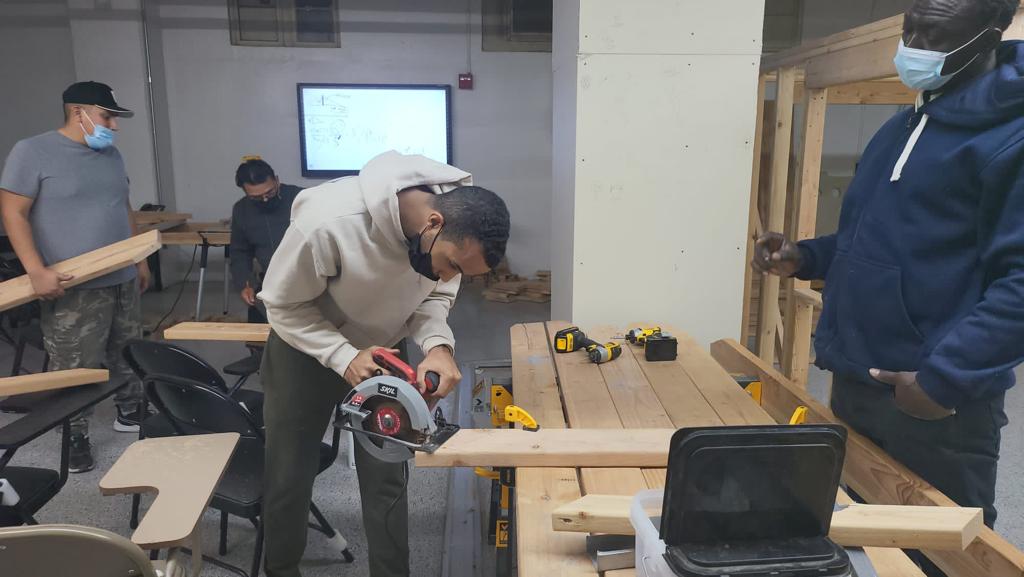
Plumbing
While many people associate plumbers with residential emergencies like clearing a clogged drain, these professionals are actually responsible for installing, maintaining, and repairing complex piping networks across the globe. From routing water to treatment plants to outfitting major residential, commercial, and industrial facilities, skilled plumbers remain in high demand. This stable career path offers continuous growth.
Program Curriculum: Plumbing
NCCER Core Curriculum Course (80 Hours)
The NCCER Core Curriculum is a prerequisite for all Level 1 craft training programs, including Plumbing. Its modules cover foundational topics—such as Basic Safety and Communication Skills—while introducing trainees to construction drawings. As an industry-recognized program, it provides the essential groundwork for a successful career in technical education. Completing this curriculum equips trainees with the fundamental skills needed to advance and pursue further education in their chosen craft.
Introduction to the Plumbing Profession (5 Hours)
Explores the diverse career pathways available within the modern plumbing industry. Delves into the history of the trade and evaluates current technologies, professional associations, workplace safety, and essential human relations skills.
Plumbing Safety (22.5 Hours)
Examines the root causes of jobsite accidents and their severe impact on project costs, schedules, and human lives. Covers the selection and deployment of Personal Protective Equipment (PPE), critical Hazard Communication (HazCom) protocols, lockout/tagout (LOTO) safety compliance, and confined-space regulations.
Tools of the Plumbing Trade (10 Hours)
Instructs trainees on the safe operation, care, and maintenance of specialized hand and power tools. Teaches proper tool selection criteria for varying mechanical tasks.
Introduction to Plumbing Math (12.5 Hours)
Reviews foundational mathematical principles—such as fractions, decimals, and squares—and applies them directly to field scenarios. Trainees will learn how to measure pipe accurately using fitting tables, framing squares, and 45-degree offset calculations.
Introduction to Plumbing Drawings (17.5 Hours)
Teaches trainees how to read, interpret, and render schematic, isometric, oblique, and orthographic plumbing prints. Focuses on translating drawing symbols to layout and installation requirements while ensuring strict code compliance.
Plastic Pipe and Fittings (12.5 Hours)
Introduces the various types of plastic piping and fittings used in modern plumbing—including ABS, PVC, CPVC, PE, PEX, and PB. Covers professional techniques for cutting, measuring, joining, supporting, and pressure-testing plastic systems.
Copper Pipe and Fittings (12.5 Hours)
Details the sizing, labeling, and applications of copper piping and related system valves. Teaches field methods for cutting, joining, insulating, handling, and pressure-testing copper assemblies while meeting local seismic codes.
Cast-Iron Pipe and Fittings (12.5 Hours)
Familiarizes trainees with hub-and-spigot and no-hub cast-iron piping systems deployed in Drain, Waste, and Vent (DWV) applications. Covers material properties, handling, structural installation, and joint-testing workflows.
Carbon Steel Pipe and Fittings (12.5 Hours)
Covers the sizing, labeling, threading, and hanging of carbon steel piping. Contrasts domestic and imported pipe characteristics, demonstrates precise cutting and joining workflows, and introduces corrugated stainless-steel tubing (CSST).
Introduction to Plumbing Fixtures (7.5 Hours)
Examines the correct application, storage, and handling of code-approved plumbing fixtures. Highlights commercial and residential installation guidelines and acceptable structural materials.
Introduction to Drain, Waste, and Vent (DWV) Systems (10 Hours)
Explains how DWV networks safely route waste away from structures and connect into public sewer systems. Analyzes how traps, vents, and drains interact, focusing on slope, grading, and sizing algorithms.
Introduction to Water Distribution Systems (10 Hours)
Identifies the primary components of water distribution systems and maps their mechanical functions. Evaluates water sources and treatment solutions while preparing trainees to manage residential and municipal supply networks.
Plumbing Math Two (15 Hours)
Advances trade math concepts by introducing the Pythagorean theorem. Focuses on field layout techniques for square corners, simple offsets, rolling offsets, and parallel piping runs.
Reading Commercial Drawings (25 Hours)
Teaches trainees how to analyze complex architectural, civil, structural, HVAC, plumbing, and electrical prints. Covers material takeoffs, Building Information Modeling (BIM), approved submittal data, and generating formal Requests for Information (RFIs).
Structural Penetrations, Insulation, and Fire Stopping (15 Hours)
Introduces safe methods for adapting structural members, insulating pipes, and installing firestops. Teaches reinforcement techniques for altered beams and proper application of fiberglass and flexible foam insulation.
Installing and Testing DWV Piping (30 Hours)
Provides step-by-step guidance on locating, installing, connecting, and testing complete DWV networks. Trainees will execute material takeoffs, set building levels, and troubleshoot building sewers.
Installing Roof, Floor, and Area Drains (5 Hours)
Covers code-compliant installation methods for roof, floor, and area drains, as well as floor sinks. Details the integration of waterproof membranes, flashing, shower pans, and trap primers.
Installing and Testing Water Supply Piping (20 Hours)
Explores advanced installation and testing workflows for entire water service systems, including meters, water heaters, softeners, and hose bibbs. Introduces backflow preventers, water hammer arrestors, and stub-out framing.
Types of Valves (5 Hours)
Reviews the distinct designs, internal components, mechanical applications, and routine maintenance protocols for standard industrial valves.
Installing Fixtures and Valves (20 Hours)
Covers the professional installation of bathtubs, shower stalls, lavatories, sinks, toilets, and urinals. Teaches how to secure associated faucets and hook up major water appliances like dishwashers, garbage disposals, and ice makers.
Installing Water Heaters (10 Hours)
Examines gas-fired, electric, tankless, heat pump, and indirect water heaters. Details internal component functions, testing techniques, and the latest national code updates.
Basic Electricity (10 Hours)
Introduces electrical safety parameters alongside foundational principles of voltage, current, resistance, and wattage. Applies critical formulas directly to electrical loops commonly managed by plumbers.
Fuel Gas and Fuel Oil Systems (20 Hours)
Outlines instructions for the safe handling, installation, and testing of natural gas, liquefied petroleum (LP) gas, and fuel oil systems, with an emphasis on identifying and mitigating potential combustion hazards.
Certifications You'll Earn
Career Outcomes
What Our Graduates Say
“I wasn't sure school was for me after everything I went through. But RTI accepted me as I was, no judgment, no barriers. Now I'm pulling permits and working on major NYC projects.”
Ricco Herrera
Licensed Plumber's Apprentice, Local Union 1
“The CRED program at Renaissance Technical Institute helped me close that gap. I didn't need someone to teach me what a wrench was. What I needed was someone to show me how things are done here. The instructors understood that. They worked with me where I was at and made sure I understood the standards, the safety requirements, the little things that matter on a job site. Earning my NCCER accreditation meant something because it showed I could do the work the right way—the way it's expected here.”
Alhassane Diallo
CRED PROGRAM - PLUMBING GRADUATE - COHORT 2
Program Info
- Duration
- 5 months
- Language
- English
- Format
- In-Person · East Harlem
- Tuition
- FREE — Zero Tuition
- Eligibility
- 17+, no diploma required, no criminal background bar
- Prerequisites
- NCCER Core Curriculum
Schedule
Contact admissions for current cohort start dates.