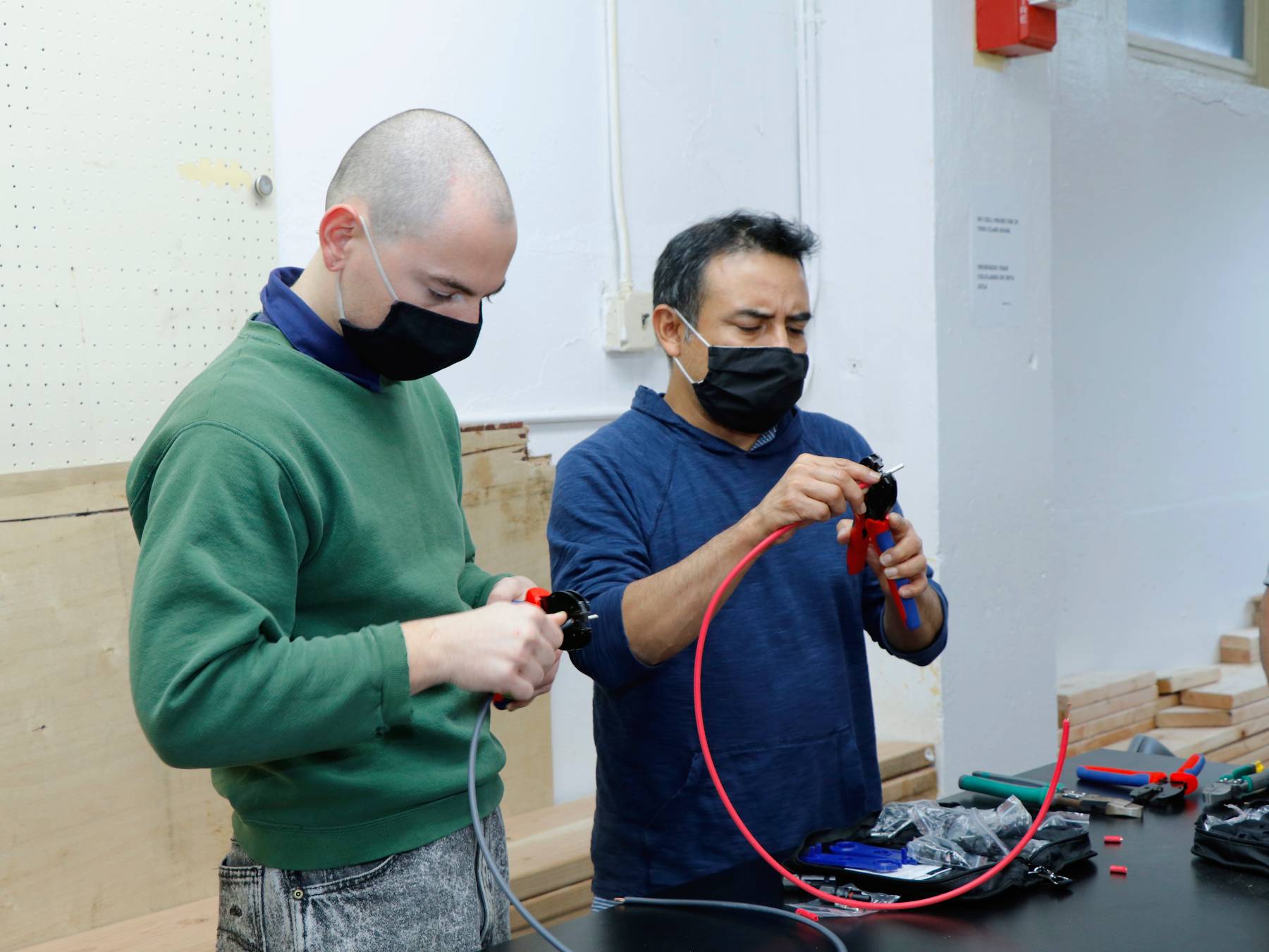
Residential & Commercial Electricity
Electricians install, maintain, and repair electrical systems in various structures. Guided by blueprints, the National Electrical Code® (NEC®), and applicable state and local regulations, they lay wiring and connect critical components such as circuit breaker panels, switches, and light fixtures.
Program Curriculum: Electrical
NCCER Core Curriculum Course (80 Hours)
The NCCER Core Curriculum is a prerequisite for all Level 1 craft training programs, including HVAC and Electrical work. Its modules cover foundational topics—such as Basic Safety and Communication Skills—while introducing trainees to construction drawings. As an industry-recognized program, it provides the essential groundwork for a successful career in technical education. Completing this curriculum equips trainees with the fundamental skills needed to advance and pursue further education in their chosen craft.
Orientation to the Electrical Trade (2.5 Hours)
Provides a comprehensive overview of the electrical industry and highlights diverse, rewarding career paths available to certified electricians.
Electrical Safety (10 Hours)
Covers vital safety rules, regulations, and workplace precautions tailored to electrical hazards. Includes hands-on familiarity with OSHA-mandated lockout/tagout (LOTO) protocols.
Introduction to Electrical Circuits (7.5 Hours)
Introduces fundamental electrical concepts and applies Ohm's law to DC series circuits. Topics include atomic theory, electromotive force, resistance, and electrical power equations.
Electrical Theory (7.5 Hours)
Explores series, parallel, and series-parallel circuits. Covers resistive circuit behavior, Kirchhoff's voltage and current laws, and practical circuit analysis.
Introduction to the National Electrical Code® (7.5 Hours)
Provides a practical roadmap for navigating the NEC®. Trainees will learn the layout, structure, and types of information found within the codebook through a streamlined, systematic lookup procedure.
Device Boxes (10 Hours)
Examines the hardware and structural systems used to mount and support boxes, receptacles, and other electrical components. It also details NEC® fill and pull requirements for small device, pull, and junction boxes (under 100 cubic inches).
Hand Bending (10 Hours)
Introduces conduit bending and installation. Focuses on techniques for utilizing hand-operated and step conduit benders, alongside proper methods for cutting, reaming, and threading conduit.
Raceways and Fittings (20 Hours)
Identifies the types, applications, and installation protocols of raceways, wireways, and ducts, with a heavy emphasis on relevant NEC® guidelines.
Conductors and Cables (10 Hours)
Focuses on the selection and application of various conductor types while mastering proper wiring techniques according to NEC® standards.
Basic Electrical Construction Drawings (7.5 Hours)
Teaches trainees how to read and interpret electrical prints, drawings, and symbols across schematics, one-lines, and wiring diagrams.
Residential Electrical Services (15 Hours)
Covers electrical devices and wiring techniques specific to residential construction and maintenance. Trainees will practice making service calculations while adhering strictly to NEC® mandates.
Electrical Test Equipment (5 Hours)
Details the selection, inspection, safety precautions, meter category ratings, and operation of common diagnostic tools, including voltage testers, clamp-on ammeters, ohmmeters, multimeters, phase/motor rotation testers, and data-recording equipment.
Alternating Current (17.5 Hours)
Describes the forces and characteristics unique to alternating-current systems, focusing on how Ohm's law applies to AC circuits.
Motors: Theory and Application (20 Hours)
Covers the core concepts of both AC and DC motors, including their main components, circuit paths, and wiring connections.
Electric Lighting (15 Hours)
Introduces the principles of human vision and the behavioral characteristics of light. Focuses on the proper handling and installation of various lamps and commercial lighting fixtures.
Conduit Bending (15 Hours)
Advances conduit bending techniques for sizes up to 6 inches, utilizing mechanical, hydraulic, and electrical benders.
Pull and Junction Boxes (12.5 Hours)
Explains how to accurately select, size, and deploy pull boxes, junction boxes, and handholes based on system demands.
Conductor Installations (10 Hours)
Covers the transportation, storage, and setup of heavy cable reels, as well as rigging methods and procedures for executing flawless cable pulls through raceways and cable trays.
Cable Tray (7.5 Hours)
Focuses on safe installation practices and strict NEC® compliance guidelines for cable trays and routing workflows.
Conductor Terminations and Splices
Demonstrates proper techniques for terminating and splicing conductors, including wire preparation and insulation taping.
Grounding and Bonding (15 Hours)
Examines the critical safety purposes of grounding and bonding electrical systems, providing a thorough breakdown of all relevant NEC® requirements.
Circuit Breakers and Fuses (12.5 Hours)
Details the operation, practical application, and sizing regulations of fuses and circuit breakers to prevent system overcurrent.
Control Systems and Fundamental Concepts (12.5 Hours)
Provides functional descriptions and real-world applications for various industrial contactors, relays, and automated control devices.
Certifications You'll Earn
Career Outcomes
What Our Graduates Say
“My experience transitioning from training to internship in my electrical program was extremely positive and rewarding. I had supportive, knowledgeable teachers and peers who were always willing to help and share what they knew. In a short amount of time, I learned a great deal of valuable information that strengthened both my skills and confidence in the field. Everyone was motivated, eager to learn, and encouraging, which created a strong learning environment. I also met people who challenged me to improve and helped me grow both professionally and personally, making this experience truly impactful.”
WELLINTON PENA
CRED PROGRAM – ELECTRICAL GRADUATE – COHORT 2
Program Info
- Duration
- 5 months
- Language
- English
- Format
- In-Person · East Harlem
- Tuition
- FREE — Zero Tuition
- Eligibility
- 17+, no diploma required, no criminal background bar
- Prerequisites
- NCCER Core Curriculum
Schedule
Contact admissions for current cohort start dates.